Archive for the 'Philosophy' Category

Triangulation = Corporate Infantilism

Wednesday, August 4th, 2010

I couldn’t have said it better myself:

Triangulation refers to a dysfunction within a team, where team member A complains about team member B to the team leader rather than to team member B directly, so that the team leader is forced to be the go between for the two. Triangulation is a form of corporate infantilism.

Forgiveness: The Intelligent Choice

The Open Source Ecosystem

Monday, June 28th, 2010

Richard Stallman was a leading proponent of free software.

However, the concept of free software is similar to the concept of free air, free water, free lumber, and free healthcare. When there is a vast quantity of it, it seems free. When we depend on it, we believe it should be a human right.  And software is sufficiently abstract and conceptual that it tempts us to believe it might indeed be free.

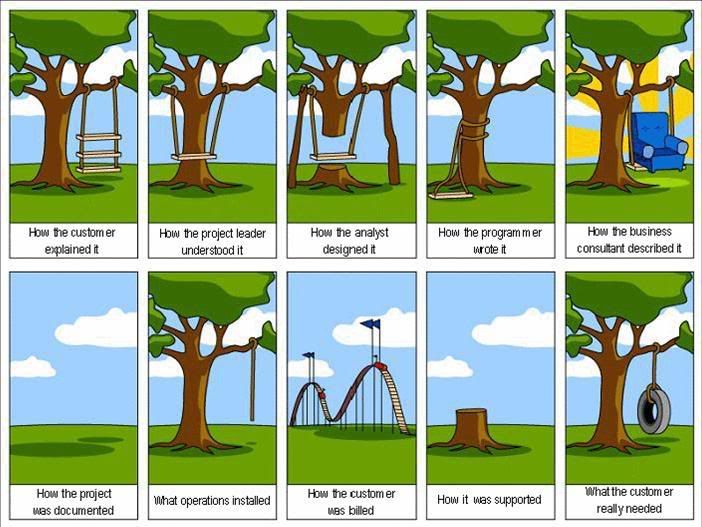
Software can be thought of as the fruit of a tree. Often, a tree yields fruit seemingly for free. Yet, we know that significant energy and resources go into the production of fruit, and that environmental conditions have an enormous effect on the yield. Thousands of years of agriculture have taught us how to nurture a tree, how to provide optimal environment and optimal quantities and quality of energy and resources to produce the ideal fruit. There have been countless trial-and-error experiments, including farms that went bankrupt due to mismanagement of environment, energy, and resources.

I submit that agriculture is far ahead of software development (agri-culture ahead of cyber-culture) in this regard.

Trees continue to reproduce by yielding fruit without human intervention, and this can be a source of wonder, but we no longer believe that fruit, especially top-quality edible fruit, is “free”.

Economic factors necessarily create significant costs along the line between conception and productive use of everything that was thought to be (or that was thought ought to be) free, including software. These costs include distribution, packaging, marketing, installation, customization, operation, and maintenance. Human beings necessarily perform some manual activities from conception to productive use of software. There are costs for providing them with life’s necessities.

It is tempting to believe that these costs are “external” or negligible, but it is foolish to believe so. They are no more external or negligible than the costs of providing fertilizer and water to trees in a farmer’s orchard.

I am not saying that free or open-source software should not exist. Indeed, buyers and sellers must question and justify payment for software when open-source equivalents, meeting the same requirements, are freely available. But by understanding why and how those equivalents exist, we can make this justification rationally. (Note: “buyers” does not refer only to end-users of software, but to developers who integrate software–operating systems, databases, web servers, etc.–into new products.)

Zen Software Development

Monday, June 28th, 2010

Software development involves following various levels of rules: rules for language syntax, rules for comprehensibility, rules for testability, scalability, essentially rules for every requirement or constraint.

When we engage in test-first development, it is as if we are writing the rules in a way that cannot be forgotten. When we write code, and the tests pass, proving that the requirements and constraints have been met, the code possesses elegance and beauty.

There is a tremendous and valuable freedom in being able to make large-scale changes in code without breaking any rules. We frequently find that rules are too strong. They have sufficient exceptions that they must be weakened.

We frequently find that rules are too weak. They allow undesirable effects to occur.

There is also satisfaction in understanding that the rules (tests) are written by us. We are free to change them if requirements change, but there is value in writing them nevertheless.

Requirements of IT for Incremental BPR

Thursday, May 6th, 2010

As hinted by Robert McDowell, Microsoft VP of Information Worker Business Value, in his keynote at Innotech 2010, fear of change is the biggest barrier to productive business process reengineering.

This is why the IT infrastructure must

  • first support and automate the existing process. This avoids knee-jerk wholesale rejection of change. It creates the “early win” that makes an organization receptive to changes.
  • also support the reengineered process. Otherwise, there is no destination for the vehicle that is the IT infrastructure.
  • also support a smooth transition from the existing to the reengineered. Discontinuous transitions are traumatic and destroy good will.
  • also support the transition from the reengineered process to the existing one. The ability to press “undo” makes people more receptive to the risks of change.

The late Michael Hammer, in his seminal Harvard Business Review article on BPR, wrote

Reengineering cannot be planned meticulously and accomplished in small and cautious steps. It’s an all-or-nothing proposition with an uncertain result. Still, most companies have no choice but to muster the courage to do it.

I disagree with this statement. Innovation, including process innovation, is less about revolution and more about evolution.

NUMMI: The Rise and Fall of Toyota and GM

Wednesday, March 31st, 2010

This is the best piece of business journalism I’ve encountered in years…a fresh take on a famous case. The only thing missing seems to be a suitable homage to W. E. Deming, the American who taught the Japanese their methods in the first place.

“Toyota execs believed their system would turn bad workers into good ones.”…and it did.

[MP3 for download]

The Best Advice I Ever Got

Tuesday, December 15th, 2009

Excerpts from Fortune, July 6, 2009

Bill Gates

Well, I’ve gotten a lot of great advice from Warren. I’d say one of the most interesting is how he keeps things simple. You look at his calendar, it’s pretty simple. You talk to him about a case where he thinks a business is attractive, and he knows a few basic numbers and facts about it. And [if] it gets less complicated, he feels like then it’s something he’ll choose to invest in. He picks the things that he’s got a model of, a model that really is predictiv and that’s going to continue to work over a long-term period. And so his ability to boil things down, to just work on the things that really count, to think through the basics–it’s so amazing that he can do that. It’s a special form of genius.

…Warren is so nice to everybody–how does he say no in a nice way? Or how does he think about priorities and have that explicitly in mind? And he turns down an unbelievable number of things, and yet everybody feels great about it. His grace in talking to people where he’s always saying, “You know, you probably understand this better than I do, but here’s how I messed it up when I first got involved in this.” You know, that’s a special talent, and I do find myself thinking, Hmm, how would Warren say this in a friendly fashion?

There was a case at the annual meeting where somebody asked a question about should you sell the stocks that have gone up and keep the ones that have not? And he sort of said, “No, you look at the value of the business.” and then Charlie [Munger] added, “He’s telling you your conceptual framework is all wrong.” Which is in fact what the answer had been, but there wasn’t one element of, “Hey, dummy…”

Jim Sinegal, Co-founder and CEO, Costco Wholesale

…[FedMart’s] founder, Sol Price, taught me a lesson that was pretty simple, but also true: If you’re going to go to the trouble of hiring someone, it’s because you can’t do the job yourself, so you better show them how you would do it.

Tory Burch, Co-founder and Creative Director, Tory Burch

When I worked [at Ralph Lauren], first in public relations and then in advertising as a copywriter, I learned the importance of having a complete vision for the company, from product to marketing to store visuals. My company is an extension of me, so when I designed my stores I wanted people to feel that they were in my home.

 Scott Boras, Sports Agent, President, Boras Corp.

…I had hired my formar law professor…He said that if you are really effective at what you do, 95% of the things said about you will be negative. Keep your head on straight, don’t get emotional, take the heat, and just make sure your clients are smiling.

Colin Powell, Former Secretary of State, Retired Four-Star General

There was a brand-new second lieutenant who was very ambitious and wanted to be a general. One night at the officer’s club the young officer spotted this old general sitting at the bar, and he went up and said, “How do I become a general?” And the general answered, “Son, you’ve got to work like a dog. You’ve got to have moral and physical courage. There may be days you’re tired, but you must never show fatigue. You’ll be afraid, but you can never show fear. You must always be the leader.” The young officer was so excited by this advice. “Thank you, sir,” he said. “So is this how I become a general?” “No,” said the general, “that’s how you become a first lieutenant, and then you keep doing it over and over.” Throughout my career, I’ve always tried to do my best today, think about tomorrow, and maybe dream a bit about the future. But doing your best in the present has to be the rule. You won’t become a general unless you become a good first lieutenant.


The Role of Discretion

Wednesday, December 2nd, 2009

One area I have struggled with in my work life is the role of discretion. In some work environments, we are expected to follow instructions repeatedly. Individual discretion and variation is frowned upon. In other work environments, repetition is precisely what is frowned upon.

In manufacturing environments, as Deming elucidated, discretion and variation should be eliminated. The more repeatable a process is, the more likely it is to scale. Individual discretion results in variation. As the process scales, variation admits error, meaning the quality of the product goes down as more are produced. A survey of business history will yield multiple examples of professionals who were richly rewarded for sustaining businesses without variation.

In research environments, repetition is considered, for good reason, utterly wasteful. Professionals are expected to discover new things always. Indeed, it is considered an advancement of science to prove that what appears new is actually something old in disguise. Careers are made or destroyed when efforts thought novel are proven derivative.

In software development, the slightest suspicion that a repeated activity might be wasteful is immediately rewarded. The activity is automated and the waste eliminated. Strict adherence to process was considered a counterproductive restriction of personal freedom.

Yet, even large-scale manufacturing systems cannot last forever. Historically, R&D departments were organized to create innovations that were then implemented in manufacturing organizations. The implicit rationale was that manufacturing required a mindset focused on strict repetition, while research required a mindset focused on purposeful variation, and those two mindsets could not exist in a single individual.  Yet this model failed so many times that its failure acquired a name: The Ivory Tower. In some cases, the  research department lost touch with the real needs of manufacturing. In other cases, manufacturing stubbornly insisted that what worked in the past would continue to work in the future.

Recently, a new model has been adopted which accepts the possibility that both mindsets can exist in the same individual. Quality Circles bring together teams from across manufacturing departments to formulate process changes—purposeful variations, innovations, and improvements. But these are separate from the execution of the processes themselves, which are expected to be invariant.

Agile software development teams are beginning to adopt this model. During the iteration, adherence to plan and process is strict, but between iterations, variations and innovations are adopted or considered. Strict adherence to process actually frees the software developer from being distracted by unimportant aspects of the work, and allows him or her to formulate innovations with greater business impact for implementation on a larger scale.

Marketing Is Everything

Monday, July 13th, 2009

A friend recently asked me what books I had found useful in learning about product management.

I mentioned this article by Regis McKenna, which first appeared in Harvard Business Review in 1991. It opened my eyes to the idea that  “marketing” is more than just lead generation, advertising, PR, or trade shows. As McKenna says,

Marketing is not a new ad campaign or this month’s promotion…It’s job is neither to fool the customer nor to falsify the company’s image. It is to integrate the customer into the design of the product and to design a systematic process for interaction that will create substance in the relationship.

Inspiring Commencement Address

Monday, June 1st, 2009

The Commencement Address to the Class of 2009, University
of Portland
, May 3rd, 2009
By Paul Hawken

When I was invited to give this speech, I was asked if I could give a
simple short talk that was “direct, naked, taut, honest, passionate,
lean, shivering, startling, and graceful.” Boy, no pressure there.

But let’s begin with the startling part. Hey, Class of 2009: you are
going to have to figure out what it means to be a human being on earth
at a time when every living system is declining, and the rate of decline
is accelerating. Kind of a mind-boggling situation but not one
peer-reviewed paper published in the last thirty years can refute that
statement. Basically, the earth needs a new operating system, you are
the programmers, and we need it within a few decades.

This planet came with a set of operating instructions, but we seem to
have misplaced them. Important rules like don’t poison the water, soil,
or air, and don’t let the earth get overcrowded, and don’t touch the
thermostat have been broken. Buckminster Fuller said that spaceship
earth
was so ingeniously designed that no one has a clue that we are on
one, flying through the universe at a million miles per hour, with no
need for seatbelts, lots of room in coach, and really good food but
all that is changing.

There is invisible writing on the back of the diploma you will receive,
and in case you didn’t bring lemon juice to decode it, I can tell you
what it says: YOU ARE BRILLIANT, AND THE EARTH IS HIRING. The earth
couldn’t afford to send any recruiters or limos to your school. It sent
you rain, sunsets, ripe cherries, night blooming jasmine, and that
unbelievably cute person you are dating. Take the hint. And here’s the
deal: Forget that this task of planet-saving is not possible in the time
required. Don’t be put off by people who know what is not possible. Do
what needs to be done, and check to see if it was impossible only after
you are done.

When asked if I am pessimistic or optimistic about the future, my answer
is always the same: If you look at the science about what is happening
on earth and aren’t pessimistic, you don’t understand data. But if you
meet the people who are working to restore this earth and the lives of
the poor, and you aren’t optimistic, you haven’t got a pulse. What I see
everywhere in the world are ordinary people willing to confront despair,
power, and incalculable odds in order to restore some semblance of
grace, justice, and beauty to this world. The poet Adrienne Rich wrote,
“So much has been destroyed I have cast my lot with those who, age after
age, perversely, with no extraordinary power, reconstitute the world.”
There could be no better description. Humanity is coalescing. It is
reconstituting the world, and the action is taking place in schoolrooms,
farms, jungles, villages, campuses, companies, refuge camps, deserts,
fisheries, and slums.

You join a multitude of caring people. No one knows how many groups and
organizations are working on the most salient issues of our day: climate
change
, poverty, deforestation, peace, water, hunger, conservation,
human rights, and more. This is the largest movement the world has ever
seen. Rather than control, it seeks connection. Rather than dominance,
it strives to disperse concentrations of power. Like Mercy Corps, it
works behind the scenes and gets the job done. Large as it is, no one
knows the true size of this movement. It provides hope, support, and
meaning to billions of people in the world. Its clout resides in idea,
not in force. It is made up of teachers, children, peasants,
businesspeople, rappers, organic farmers, nuns, artists, government
workers, fisherfolk, engineers, students, incorrigible writers, weeping
Muslims, concerned mothers, poets, doctors without borders, grieving
Christians, street musicians, the President of the United States of
America, and as the writer David James Duncan would say, the Creator,
the One who loves us all in such a huge way.

There is a rabbinical teaching that says if the world is ending and the
Messiah arrives, first plant a tree, and then see if the story is true.
Inspiration is not garnered from the litanies of what may befall us; it
resides in humanity’s willingness to restore, redress, reform, rebuild,
recover, reimagine, and reconsider. “One day you finally knew what you
had to do, and began, though the voices around you kept shouting their
bad advice,” is Mary Oliver’s description of moving away from the
profane toward a deep sense of connectedness to the living world.

Millions of people are working on behalf of strangers, even if the
evening news is usually about the death of strangers. This kindness of
strangers has religious, even mythic origins, and very specific
eighteenth-century roots. Abolitionists were the first people to create
a national and global movement to defend the rights of those they did
not know. Until that time, no group had filed a grievance except on
behalf of itself. The founders of this movement were largely unknown
Granville Clark, Thomas Clarkson, Josiah Wedgwood and their goal was
ridiculous on the face of it: at that time three out of four people in
the world were enslaved. Enslaving each other was what human beings had
done for ages. And the abolitionist movement was greeted with
incredulity. Conservative spokesmen ridiculed the abolitionists as
liberals, progressives, do-gooders, meddlers, and activists. They were
told they would ruin the economy and drive England into poverty. But for
the first time in history a group of people organized themselves to help
people they would never know, from whom they would never receive direct
or indirect benefit.. And today tens of millions of people do this every
day. It is called the world of non-profits, civil society, schools,
social entrepreneurship, and non-governmental organizations, of
companies who place social and environmental justice at the top of their
strategic goals. The scope and scale of this effort is unparalleled in
history.

The living world is not “out there” somewhere, but in your heart. What
do we know about life? In the words of biologist Janine Benyus, life
creates the conditions that are conducive to life. I can think of no
better motto for a future economy. We have tens of thousands of
abandoned homes without people and tens of thousands of abandoned people
without homes. We have failed bankers advising failed regulators on how
to save failed assets. Think about this: we are the only species on this
planet without full employment. Brilliant. We have an economy that tells
us that it is cheaper to destroy earth in real time than to renew,
restore, and sustain it. You can print money to bail out a bank but you
can’t print life to bail out a planet. At present we are stealing the
future, selling it in the present, and calling it gross domestic
product. We can just as easily have an economy that is based on healing
the future instead of stealing it. We can either create assets for the
future or take the assets of the future. One is called restoration and
the other exploitation. And whenever we exploit the earth we exploit
people and cause untold suffering. Working for the earth is not a way to
get rich, it is a way to be rich.

The first living cell came into being nearly 40 million centuries ago,
and its direct descendants are in all of our bloodstreams. Literally you
are breathing molecules this very second that were inhaled by Moses,
Mother Teresa, and Bono. We are vastly interconnected. Our fates are
inseparable. We are here because the dream of every cell is to become
two cells. In each of you are one quadrillion cells, 90 percent of which
are not human cells. Your body is a community, and without those other
microorganisms you would perish in hours. Each human cell has 400
billion molecules conducting millions of processes between trillions of
atoms. The total cellular activity in one human body is staggering: one
septillion actions at any one moment, a one with twenty-four zeros after
it. In a millisecond, our body has undergone ten times more processes
than there are stars in the universe exactly what Charles Darwin
foretold when he said science would discover that each living creature
was a “little universe, formed of a host of self-propagating organisms,
inconceivably minute and as numerous as the stars of heaven.”

So I have two questions for you all: First, can you feel your body? Stop
for a moment. Feel your body. One septillion activities going on
simultaneously, and your body does this so well you are free to ignore
it, and wonder instead when this speech will end. Second question: who
is in charge of your body? Who is managing those molecules? Hopefully
not a political party. Life is creating the conditions that are
conducive to life inside you, just as in all of nature. What I want you
to imagine is that collectively humanity is evincing a deep innate
wisdom in coming together to heal the wounds and insults of the past.

Ralph Waldo Emerson once asked what we would do if the stars only came
out once every thousand years. No one would sleep that night, of course.
The world would become religious overnight. We would be ecstatic,
delirious, made rapturous by the glory of God. Instead the stars come
out every night, and we watch television.

This extraordinary time when we are globally aware of each other and the
multiple dangers that threaten civilization has never happened, not in a
thousand years, not in ten thousand years. Each of us is as complex and
beautiful as all the stars in the universe. We have done great things
and we have gone way off course in terms of honoring creation. You are
graduating to the most amazing, challenging, stupefying challenge ever
bequested to any generation. The generations before you failed. They
didn’t stay up all night. They got distracted and lost sight of the fact
that life is a miracle every moment of your existence. Nature beckons
you to be on her side. You couldn’t ask for a better boss. The most
unrealistic person in the world is the cynic, not the dreamer.
Hopefulness only makes sense when it doesn’t make sense to be hopeful
This is your century. Take it and run as if your life depends on it.

Paul Hawken is a renowned entrepreneur, visionary environmental
activist, and author of many books, most recently Blessed Unrest: How
the Largest Movement in the World Came into Being and Why No One Saw It
Coming. He was presented with an honorary doctorate of humane letters by
University president Father Bill Beauchamp, C.S.C., in May, when he
delivered this superb speech. Our thanks especially to Erica Linson for
her help making that moment possible.

Update: Staying Positive

Sunday, February 8th, 2009

A friend and former colleague pointed out this BusinessWeek article about a course on happiness at Harvard. I also found this book by His Holiness the Dalai Lama to be practical and helpful:


 Did you know you could follow His Holiness the Dalai Lama on Twitter?