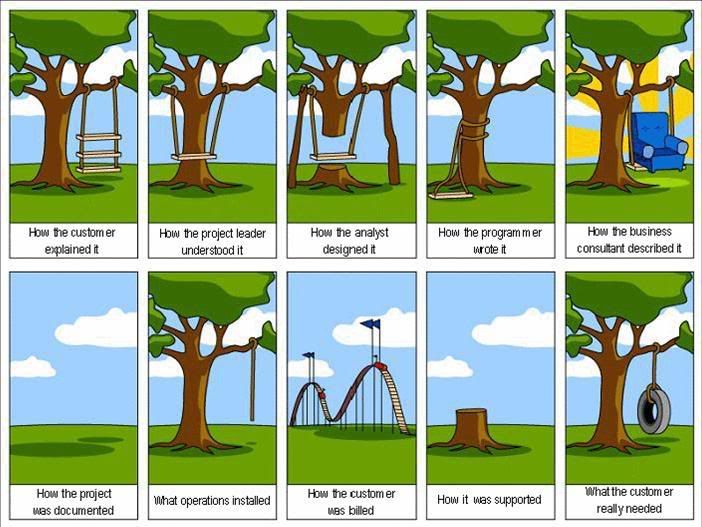
iovation was going through a rapid growth phase. Product enhancement requests from customers, executives, customer support, and engineers were piling up. Features were being delivered, but there was significant dissatisfaction with their nature, completeness, and timing.
(more)
iovation was going through a rapid growth phase. Product enhancement requests from customers, executives, customer support, and engineers were piling up. Features were being delivered, but there was significant dissatisfaction with their nature, completeness, and timing. \ I achieved the following:
- using Ruby on Rails and MySQL, built a requirements management application
- organized these requests and consolidated similar requests from multiple customers
- exposed unstated requirements, and built mockups and prototypes (again using Ruby on Rails and MySQL) to validate requirements before engineering resources were invested
- established traceability from engineering requirements to the specific needs of customers and markets. This gave the development organization the confidence that their work would be adopted and valued.
- worked closely with the development and QA organization to prioritize requirements based on their value to customers. We collaborated on maintaining a Scrum backlog. This helped the organization focus on what would build value for the company and its customers.
- communicated development constraints to customers and clarified customer needs for development and QA. This two-way communication served to re-build trust throughout the organization.
As a consequence, the development organization delivered multiple product releases that satisfied customers.
(less)
Director of Product Management | iovation, Inc. | June 2008 - December 2008
In discussions with product management professionals, it became clear that many organizations faced a similar problem: They expected a return (in the form of sales revenue) on their product development investment (in the form of labor or capital costs). Unfortunately, as known and unknown risks came to fruition, they ended up "throwing good money after bad," to the severe detriment of the product and the organization.
(more)
In discussions with product management professionals, it became clear that many organizations faced a similar problem: They expected a return (in the form of sales revenue) on their product development investment (in the form of labor or capital costs). Unfortunately, as known and unknown risks came to fruition, they ended up "throwing good money after bad," to the severe detriment of the product and the organization.
In response, I developed a simple methodology for product planning and risk mitigation.
It was described in a webinar entitled Risk, ROI, and Real Options in One Page
(less)
Director of Product Management | Corillian | February 2007
Corillian powered the internet banking sites of some of the world's largest financial institutions. We had to maintain the highest standards for web application security.
(more)
Corillian powered the internet banking sites of some of the world's largest financial institutions. We had to maintain the highest standards for web application security. We developed two security products:
- Corillian Fraud Detection System, a tool to expose early stages of phishing attacks.
- Intelligent Authentication, a multi-factor authentication solution that was minimally intrusive to internet banking users.
In my role as product manager for these products, I achieved the following:
- definition of target markets. Definitions that were specific without being narrow ensured that our solutions would satisfy customers and that sales would proceed predictably.
- identification of technology and channel partners. Careful vetting of partners ensured the feasibility of joint solution delivery and good lead generation
I also supported outbound product marketing by:
- delivering a presentation at NACHA Payments 2006
- writing an article for Bank Technology News
- producing and delivering presentations to customers and prospects
- producing content for web site and data sheets
- working with industry analysts to ensure fair and favorable representation of our products
- analyzing the competition to ensure customer decisions in our favor in sales situations
- being the subject-matter expert for the product in training and supporting sales
(less)
Director of Product Management | Corillian | May 2005 - May 2008
In an effort to extend its market beyond online banking for consumers, Corillian decided to transform a custom small business online banking implementation into a full-fledged product.
(more)
Corillian had previously sold a custom small business online banking solution to M&T Bank, and I had been the engineering manager responsible for its delivery. In an effort to extend its market beyond online banking for consumers, Corillian decided to transform a the solution into a full-fledged product, and I became the product manager. My responsibilities included
- defining the product roadmap
- market research
- evangelism inside the company
- gathering requirements and communicating them to the development organization
This product line generated nearly $15 million in revenue from top-ten banks like JP Morgan Chase as well as smaller institutions.
(less)
Director of Product Management | Corillian | 2002 - 2005
In 2003, Corillian took a hard look at the markets it was serving and accessible markets that we were leaving underserved.
(more)
In 2003, Corillian took a hard look at the markets it was serving and accessible markets that we were leaving underserved. I conducted an in-depth analysis of the market and competition and successfully directed Corillian's entry into online corporate banking and increased investment in small business online banking. The results of my study were presented to, and favorably received, by executive staff, Wall Street analysts, industry analysts, and Corillian’s board of directors.
(less)
Director of Product Management | Corillian | 2003
As Corillian grew its customer base and revenue, its development organization had to scale and mature.
(more)
As Corillian grew its customer base and revenue, its development organization had to scale and mature. I started at Corillian with two direct reports, and by the time I moved out of engineering, my organization had grown to 26, of which five engineering managers reported directly to me.
In my last six months in engineering, I was responsible for Corillian's entire product line, which generated $19 million during that period, and another $20 million in the following six months. My annual budget was approximately $2 million.
As an engineering manager, I achieved the following:
- led junior and senior managers to on-time delivery of Corillian internet banking products
- developed ROI measures for products and even features, in cooperation with product management. \ This helped us set priorities objectively and communicate them throughout the company.
- Rescued two difficult projects and retained customers by establishing reasonable expectations and rebuilding their trust in Corillian’s ability to make and meet delivery commitments. Business from these customers alone subsequently exceeded $4.1 million.
- established standards for product requirements in cooperation with product management. This helped product management develop high-quality requirements and reduced requirements thrash which sometimes afflicts a growing organization.
- established quality standards, measures, and iterative quality-focused development processes in cooperation with QA management
- instituted agile development processes, policies and progress reporting expectations in cooperation with the project management office.
- Conducted practical training on software development methodologies including Rational Unified Process, eXtreme Programming, Refactoring, and software inspections.
- Successfully managed an off-site partner and an off-shore development team who were developing technology components.
(less)
Director of Product Development | Corillian | May 1998 - July 2002
In 1998, Corillian was a one-year-old start-up with a couple of internet banking products. The company had to differentiate itself from larger competitors and close business with marquee customers in its market.
(more)
In 1998, Corillian was a one-year-old start-up with a few internet banking products. The company had to differentiate itself from larger competitors and close business with marquee customers in its market.
I was a software engineering manager, and used prototypes as part of my overall development process. Two prototypes developed by my team were especially valuable to Corillian:
- A prototype of the MoneyPAD product attracted traffic to our trade show booth as an exciting innovation in internet banking.
- A prototype implementation of our OFX Server proved its technical feasibility to Citibank, giving us a marquee customer.
(less)
Project Manager | Corillian | May 1998 - August 1999
By 1994, Moore's Law had created a challenge for Intel Corporation: business and consumer software applications drove the majority of demand for microprocessors. However, software's need for faster and faster microprocessors was diminishing.
(more)
By 1994, Moore's Law had created a challenge for Intel Corporation: business and consumer software applications drove the majority of demand for microprocessors. However, software's need for faster and faster microprocessors was diminishing.
Intel Architecture Labs was charged with dreaming up compelling applications that would drive demand for next-generation microprocessors. We operated by developing prototypes, filing patents on our intellectual property, and demonstrating our prototypes to internal product groups and independent software vendors. As our prototypes were picked up, demand for Intel's processors increased, and our patents could be licensed for some revenue as well.
As a software engineer in Intel Architecture Labs, I authored or co-authored the following patents:
- 6,598,045: System and method for piecemeal relevance evaluation
- 6,172,685: Method and apparatus for increasing the amount and utility of displayed information
- 5,899,995: Method and apparatus for automatically organizing information
- 5,859,636: Recognition of and operation on text data
(less)
Senior Software Engineer | Intel Corporation | September 1994 - May 1998
Intel's Supercomputer Systems Division faced a serious problem. Delays in the availability of hardware prevented the downstream operating system group from developing its software, and delays in the development of the operating system prevented the downstream application group from developing its software.
(more)
Intel's Supercomputer Systems Division faced a serious problem. Delays in the availability of hardware prevented the downstream operating system group from developing its software, and delays in the development of the operating system prevented the downstream application group from developing its software.
As a member of the operating system group, I recognized this problem and developed a software prototype of the operating system that simulated the function of the hardware. The following benefits accrued:
- the application group was able to develop and even test its libraries before the hardware was available
- when the actual hardware was finally made available, the software groups were able immediately to report any defects
- modifications to the application group's software, to make it run on the hardware, were minimized
(less)
Senior Software Engineer | Intel Corporation | November 1991 - September 1994